In October, Gunnar Cedersund, Scientific Coordinator of M4-HEALTH, took part in meetings in Brussels focused on the European Commission’s Advanced Virtual Human Twins initiative.
The initiative aims to establish a shared computational platform where researchers can upload models, combine them with data and run simulations to advance digital twin technology in healthcare. The platform could become an important foundation for future European research projects as well as for medical practice.
During this meeting, we discussed how to align this European initiative and computational platform with the M4-HEALTH network. One of the main contributions of the M4-HEALTH network will be to look more closely at how to combine different sub-models with each other into an interconnected model for the body as a whole. This is not something that is at focus on the European Commission’s Virtual Twin initiative, but it lies at the heart of M4-HEALTH – more specifically, this integration concerns the lower green part of the figure below, and all arrows going into the digital twin.
In October, Gunnar Cedersund, ISB Group Leader and Scientific Coordinator of M4-HEALTH, visited two research groups Dura-Bernal Lab and Biodynamics Lab – both M4-HEALTH collaborators – in New York to discuss developments in computational modelling, AI and digital health.
At the Dura-Bernal Lab, discussions focused on the growing use of AI agents in computational neuroscience, with potential applications in e-health and Parkinson’s disease.
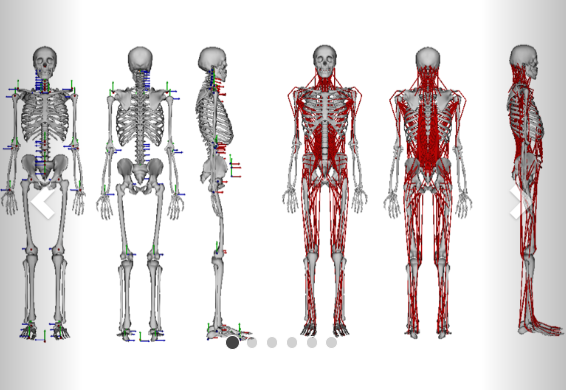
At the Biodynamics Lab led by Dr Alex Zhou at the New Jersey institute of Technology (NJIT), Gunnar and Alex discussed the possible applications of their advanced biomechanical models of the human body, including muscles, joints and human–robot interaction. These models could help improve our understanding of movement difficulties and support the development of exoskeletons. These biomechanical models will be of great value in e.g. the neighboring STRATIF-AI project, where we use digital twins to visualize and analyze movements in connection to stoke rehabilitation. In M4-HEALTH, this new technology will also have applications in e.g. movement analysis of athletes, for personal trainers, for physiotherapists, etc.
Both visits highlighted the potential of combining AI, computational modelling and human physiology to develop more accurate digital models and advance personalized healthcare.
Gunnar Cedersund – Scientific Coordinator of M4-HEALTH was invited to give a lecture about hybrid digital twins and M4-HEALTH at the American Conference on Pharmacometrics (ACoP 2026). At ACoP 2026, one of the major US conferences in pharmacometrics, around 1,000 participants from academia and industry gathered to discuss how modelling and simulation are transforming drug development. New knowledge-driven drug development is central to M4-HEALTH and we have a dedicated sub-cluster M4-Drug Development. The basis for this new approach was recently published earlier this year in European Journal of Pharmaceutical Sciences.
At the heart of this new approach lies not only digital twins but also microphysiological systems: technologies that recreate aspects of human organs in miniature, such as organ-on-a-chip models. Researchers and industry representatives, including Gunnar Cedersund and a team from AstraZeneca in the US, presented approaches combining these systems with computer models to predict drug toxicity and adverse effects.
The potential is significant. According to results presented at the conference, traditional animal models showed limited predictive ability in a particular comparison, while a combined approach using microphysiological and computational models achieved approximately 95% predictive accuracy. These approaches could help reduce reliance on animal experiments while improving predictions of how medicines affect humans.
Another major theme was the growing role of AI agents in pharmacometrics. Multiple sessions focused on how AI agents can contribute to pharmacological modelling and become part of scientific decision-making. But greater autonomy also brings new demands: models and AI-driven processes must be reproducible, validated and open to scrutiny.
The US Food and Drug Administration (FDA) also addressed developments in this area, reflecting the growing importance of establishing appropriate frameworks for using AI in drug development.
The key takeaway: The future of drug development lies not in a single technology, but in combining biological models, computational simulations and AI. The challenge is to make these approaches not only powerful, but also reliable and transparent enough to support real-world decisions about medicines.
M4-HEALTH and ISB Group Head of Communications Katja Woxell is now touring around Linköping, Stockholm, Gothenburg, Lund and Malmö, interviewing some of the prominent M4-HEALTH stakeholders – cancer researchers, toxicologists and forensic experts, experts in systems pharmacology, experts in food industry as well as experts in physical training and community building for preventive healthcare.
M4-CANCER
In mid-October, she interviewed Linda Bojmar and Constantinos Zambirinis – two top-level translational cancer researchers at Linköping University who have discovered microscopic changes occurring in the liver that can be used to predict if, and where, pancreatic cancer may spread in the body. Constantinos and Linda’s research as well as Constantinos’ practical healthcare perspective as a surgical oncologist power the M4-HEALTH sub-cluster M4-Cancer.
We interviewed Linda and Constantinos about their research and its relevance to M4-HEALTH as well as about their newly submitted EU application which plans on full integration of our medical digital twins in their cancer research.
M4-SENIORS
Later that week, Katja Woxell traveled to Stockholm and interviewed Johan Holmsäter – Founder of Friskis & Svettis. Johan is a key actor in the sub-cluster M4-SENIORS and has developed a healthcare program ”Livshanteringsprogrammet” which is being implemented by Norlandia – one of Europe’s largest elderly care companies – along with our hybrid digital twins.
The interviews are in the post-production process and will be released soon on our website and on social media.
On October 13, it was time for HEALTH HUB – an annual event that brings together business leaders, researchers, healthcare professionals and decision-makers to focus on preventive healthcare.
For the second year in a row Gunnar Cedersund – ISB Group Leader and Scientific Coordinator of M4-HEALTH – was a speaker at this event and the audience kept cheering on him as he was presenting M4-HEALTH, hybrid digital twins and M4-HEALTH ecosystem-based approach to healthcare. Of course, the presentation also led to several requests for collaboration with M4-HEALTH, and we are looking forward to taking up those discussions.
The event was a celebration of enthusiasm, knowledge and courage to do one’s bit in moving towards a preventive healthcare ecosystem: The speakers covered a wide range of topics, from systematic approaches to workplace health to the chain reactions between different organs, including the role of oral health. They also explored how we can move from a metabolic pandemic towards more healthy years filled with sustained energy, and highlighted the importance of social relationships for well-being, motivation and preventing a collapse by helping recognize the warning signs early. All in all, a series of thought-provoking and inspirational talks!
M4-HEALTH is a proud participant of HEALTH HUB by HOLISTAL. Holistal, together with Oskar Halling Ullberg and Dr. Mouna Esmaeilzadeh that Gunnar shared stage with, are a part of M4-HEALTH. We are looking forward to working with our colleagues towards shared healthcare goals as well as looking forward to getting to know all the companies and people that approached us with collaboration ideas during and after the event.
Many thanks to Holistal CEO Birgitta Thörn for this fruitful event.
Our team member Henrik Podéus Derelöv, together with his colleagues at Linköping University and the Swedish National Board of Forensic Medicine has developed a digital twin model designed to improve the forensic reconstruction of alcohol consumption. By integrating individual physiological characteristics—such as sex, age, height, weight, and medical conditions—with data from breath, blood, and urine samples, the model enables more precise estimations of when and how much alcohol a person consumed. This approach paves the way for more reliable investigations into crimes where alcohol is believed to have been involved, and it addresses limitations in current forensic methods, particularly in cases involving the “hip flask defence,” where individuals claim alcohol was consumed only after the incident. The model also incorporates factors influencing alcohol absorption and metabolism, including gastric emptying, food intake and the type of alcoholic beverage consumed. Although the framework does not eliminate uncertainty, it offers a more flexible and reliable tool to support forensic investigations involving alcohol-related crimes and accidents.
Henrik Podéus – PhD student at the Department of Biomedical Engineering (IMT) and ISB Group member behind the research
Gunnar Cedersund held a presentation on our digital twins at the annual event “Healthy Vascular Aging Symposium”, at Danderyd’s hospital, on April 21. The event was arranged by the Swedish Organization for hypertension, stroke, and vascular medicine, which is a national network for scientists and clinicians. Apart from this annual event, they also arrange a study group for Ph.D. students in the field.
This year’s event had a special focus, and apart from Gunnar’s presentation on digital twins and Henrik Hellqvist’s presentation on machine learning (photo below), there was an interesting lecture by Ljubica Matic, from Ulf Hedin’s group. Together, these three presentations created a nice flow: the large database for vascular health built up by the Hedin and Matic, traditional ML-based analysis of such data, and our own hybrid approaches, including all other organs and longitudinal data, among others.
At the event, we also went through our upstarting and exciting M4-HEALTH project, which includes digital twins not only for vascular health, but also for all other medical applications, including even non-clinical actors. Read more about our excellence cluster on m4-health.se and don’t miss our next workshop, on May 25-26.
Is knowledge enough to create better life conditions for everyone? I remember the PhD proposal I wrote three years ago: I stated in that proposal that I did not want to do science just for the sake of knowledge. I wanted to do science to make better healthcare possible in the real world – here and now – and make it inclusive, centered around an individual. I did not get the PhD position. Instead, life blessed me with this:
On January 28, 2026 I traveled to Linköping University Hospital to join my colleagues – visionaries – not only one of a kind experts in their respective fields but also revolutionists who are building the future of healthcare – the healthcare that each and every one of us, no doubt, has wished for at least once when we have dealt with healthcare systems: A health ecosystem that treats each and every one of us as humans whose unique health journeys are formed through equally uniquely intertwined factors – information that current healthcare system does not have the capacity to gather, not to mention the capacity to help individuals or healthcare professionals use it as actionable data for disease prevention.
I was there as the Press Officer of the world-unique Medical Digital Twin which allows individuals to gather their physiological and cognitive health data – from the intracellular level to the whole-body response – to account for all major functionalities in the body, make informed lifestyle decisions now and predict how one’s health state will develop over years.
So why did we gather in January? With Medical Digital Twin at its heart, we have built M4-HEALTH – an excellence cluster bringing together an even larger pool of experts in healthcare, drug development, defense, forensics, elderly care, AI and data handling as well as food and textile industries to transform our current reactive and hospital-centric healthcare system into a preventive, personalized, ecosystem-based approach.
To go back to my rhetorical question at the beginning – Is knowledge enough to create better life conditions for everyone? It takes more than knowledge. In M4-HEALTH we have world-class knowledge and expertise. We have hearts that beat for change. And we have a vision that we are all fiercely dedicated to, no matter what role we are currently playing in the excellence cluster. I believe that is that foundation of using knowledge for the best for everyone.
And if you want one more hint of a personal touch… When I was a little girl and breathed books like one breathes air, I always envisioned myself doing revolutionary things. But I had no idea this is where my life would take me.
Speaking of visionaries, here are two people that inspire me: Gunnar Cedersund that has united so many of us around his vision of what the future of health can look like, and Johan Holmsäter that has revolutionized our perspective on physical health once and is on his second round.